
You download a VPN. You click “connect.” A small green icon appears. Instantly, you feel safer. But here’s the real question: what makes a VPN private in the first place?
A flashy interface doesn’t guarantee security. A bold “no-logs” claim doesn’t automatically protect your browsing. Privacy is built on layers, not slogans.
If you truly want to understand what makes a VPN private, you need to look beyond marketing language. You need to examine technology, policies, infrastructure, and transparency. Let’s break it down clearly and practically.
Understanding What Makes a VPN Private at Its Core
At its foundation, what makes a VPN private is simple: your online activity cannot be traced back to you.
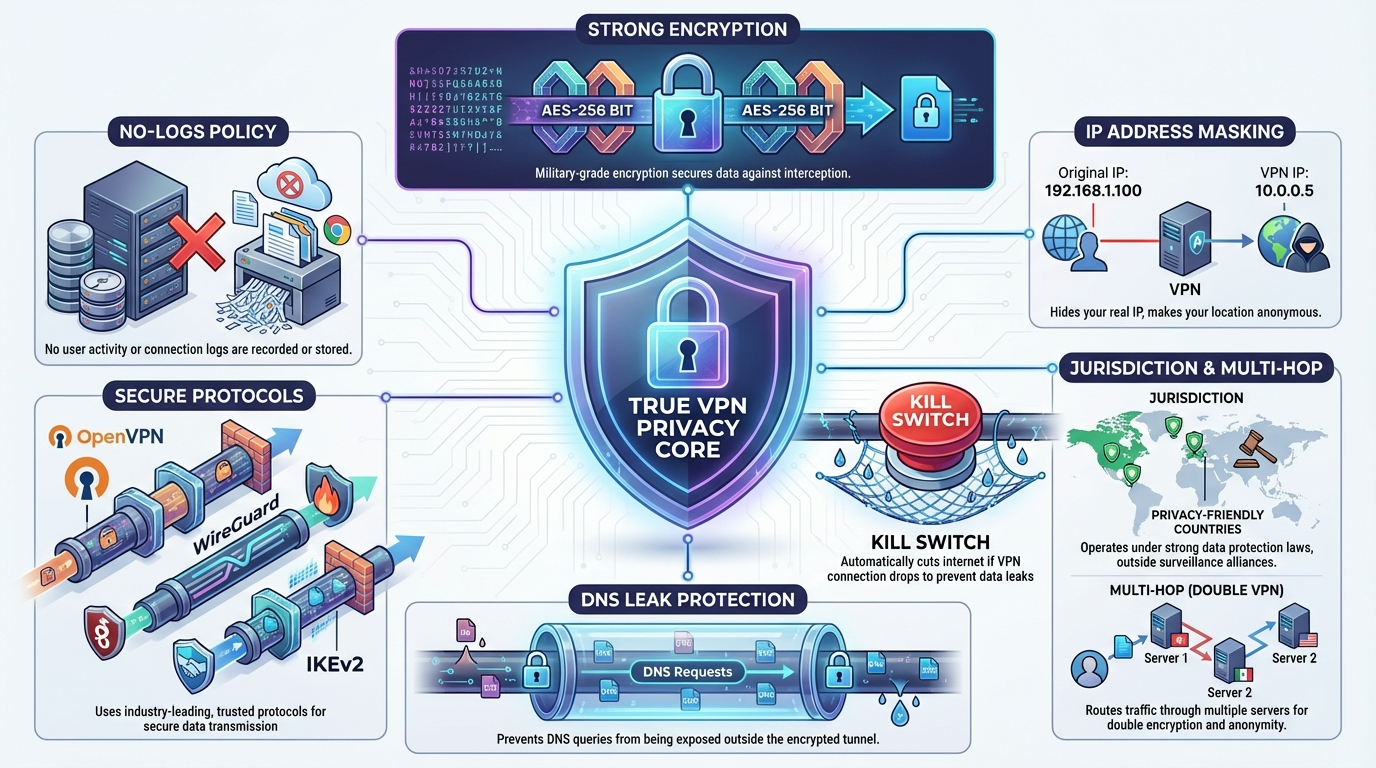
However, achieving that outcome involves multiple moving parts. Encryption protects data in transit. No-logs policies prevent stored records. Secure servers prevent leaks. Legal jurisdictions influence data handling.
If even one component fails, privacy weakens.
Think of a VPN like a secure tunnel. Your data travels through it instead of moving openly across the internet. Yet the tunnel must be built correctly. If it leaks or records traffic, the protection becomes symbolic rather than real.
Therefore, evaluating privacy requires examining each structural layer carefully.
Strong Encryption: The First Layer of What Makes a VPN Private
Encryption transforms readable data into scrambled code. Without the proper key, that code remains meaningless.
Most reputable providers use AES-256 encryption. This standard is considered extremely secure. It is trusted by governments and cybersecurity professionals worldwide.
Additionally, secure protocols like OpenVPN and WireGuard enhance protection. These protocols determine how data moves through the encrypted tunnel.
If a VPN uses outdated or weak protocols, privacy can be compromised. Therefore, encryption quality is one of the first answers to what makes a VPN private.
Without strong encryption, the tunnel collapses.
No-Logs Policies and Data Collection Practices
Encryption protects data while it travels. However, logging policies determine what happens after it reaches the VPN server.
A true no-logs policy means your browsing history, IP address, and session details are not recorded. If nothing is stored, nothing can be handed over later.
However, some providers collect limited connection metadata. While this may not include browsing history, it can still reduce anonymity.
To understand what makes a VPN private, read the privacy policy carefully. Look for clear statements about:
- Activity logs
- Connection timestamps
- IP address storage
- Bandwidth tracking
Transparency in documentation strengthens trust.
Independent Audits and Transparency Reports
Claims alone are not enough. What makes a VPN private often depends on verification.
Independent audits conducted by third-party firms examine server infrastructure and logging systems. If an audit confirms no identifiable logs are stored, confidence increases.
Additionally, transparency reports showing government data requests add credibility.
When privacy claims are tested publicly, trust becomes evidence-based rather than theoretical.
Therefore, verified audits represent a strong indicator of genuine privacy.
Secure Server Infrastructure
Infrastructure design also defines what makes a VPN private.
Many leading providers now use RAM-only servers. These servers store data temporarily in memory rather than on hard drives. When rebooted, all information disappears automatically.
This approach significantly reduces risk. Since no persistent storage exists, logs cannot accumulate.
Moreover, providers that own and manage their servers directly maintain greater control over security.
Infrastructure investment signals commitment to privacy beyond surface-level promises.
Kill Switch and Leak Protection
Even strong encryption can fail if a connection drops unexpectedly.
A kill switch automatically disconnects your device from the internet if the VPN connection fails. This prevents your real IP address from being exposed.
Additionally, DNS leak protection ensures that domain name requests do not bypass the encrypted tunnel.
WebRTC leak prevention protects browser-based connections.
These safeguards answer part of what makes a VPN private in practical terms. They prevent accidental exposure.
Jurisdiction and Legal Environment
Location matters. A VPN company operates under the laws of its registered country.
Some countries enforce mandatory data retention policies. Others participate in intelligence-sharing alliances.
Although a strong no-logs policy reduces risk, jurisdiction influences legal pressure.
Therefore, when evaluating what makes a VPN private, consider both infrastructure and legal context.
A privacy-friendly jurisdiction adds another protective layer.
Open-Source Software and Code Transparency
Some VPN providers publish parts of their software as open source. This allows security experts to examine the code for vulnerabilities.
Open-source transparency builds confidence. While most users will not inspect code personally, public availability encourages accountability.
If developers invite scrutiny, they signal confidence in their product.
Transparency at the code level reinforces privacy credibility.
Payment Privacy and Anonymous Options
Privacy extends beyond browsing activity. Payment methods can also reveal identity.
Some VPN providers accept cryptocurrency or prepaid payment options. These methods reduce the personal information linked to your account.
While not essential for everyone, anonymous payment options strengthen privacy for those who need it.
What makes a VPN private often includes minimizing data collection at every stage.
Data Minimization Principles
Strong privacy-focused providers collect only necessary operational data.
For example, email addresses may be required for account management. However, excessive personal information should not be requested.
Data minimization reduces risk. If less information is collected, less can be exposed.
Review registration requirements carefully. Simplicity often reflects stronger privacy principles.
Performance Without Compromise
Privacy should not destroy usability.
If a VPN slows your connection drastically, you may disconnect it frequently. That behavior weakens protection.
Therefore, what makes a VPN private also includes consistent performance. When encryption runs smoothly, you keep it active.
Reliability supports continuous protection.
Customer Support Transparency
Transparent communication matters. If you ask about logging policies, answers should be clear and direct.
Ambiguous responses suggest uncertainty.
Trustworthy providers offer detailed knowledge bases and responsive support.
Open communication reinforces privacy confidence.
Red Flags to Watch For
Not all VPNs are created equal. Certain warning signs indicate weak privacy foundations.
Be cautious if you see:
- Vague privacy policies
- No audit documentation
- Excessive app permissions
- Extremely low pricing with unclear revenue models
- Poor transparency about ownership
These signals undermine confidence.
Evaluating red flags clarifies what makes a VPN private versus merely marketed as private.
Testing Privacy Yourself
You can verify certain aspects independently.
Run DNS and IP leak tests while connected. Confirm your real IP address remains hidden.
Review app permissions on mobile devices. Ensure access aligns with functionality.
Research company ownership and corporate history.
Although you cannot inspect server code directly, these steps strengthen informed decision-making.
Balancing Trust and Verification
Understanding what makes a VPN private requires both trust and evidence.
Trust begins with clear policies. Evidence comes from audits, infrastructure design, and consistent performance.
Just as you review bank statements, you should periodically review your VPN provider.
Verification strengthens confidence.
Conclusion: Privacy Is Built on Layers
So, what makes a VPN private? It is not a single feature. It is a combination of strong encryption, strict no-logs policies, secure server infrastructure, leak protection, transparent audits, and responsible data practices.
Privacy is built like a fortress. Each wall supports the next. Remove one, and the structure weakens.
Before subscribing, examine each layer carefully. Read policies. Review audits. Test performance. Ask questions.
When you understand the foundations of true VPN privacy, you move beyond marketing claims. You choose protection backed by technology, transparency, and accountability. That informed choice ensures your online activity remains truly yours.
FAQs
- What makes a VPN private compared to other VPNs?
Strong encryption, verified no-logs policies, secure servers, and independent audits define true privacy. - Are no-logs claims always reliable?
Not always. Independent audits and transparency reports provide stronger verification. - Does encryption alone guarantee privacy?
No. Logging practices and infrastructure design also determine overall protection. - Is jurisdiction important for VPN privacy?
Yes, legal environments influence data handling and government request policies. - How can I test if my VPN is truly private?
Run DNS and IP leak tests, review privacy policies, and check for independent audits.