
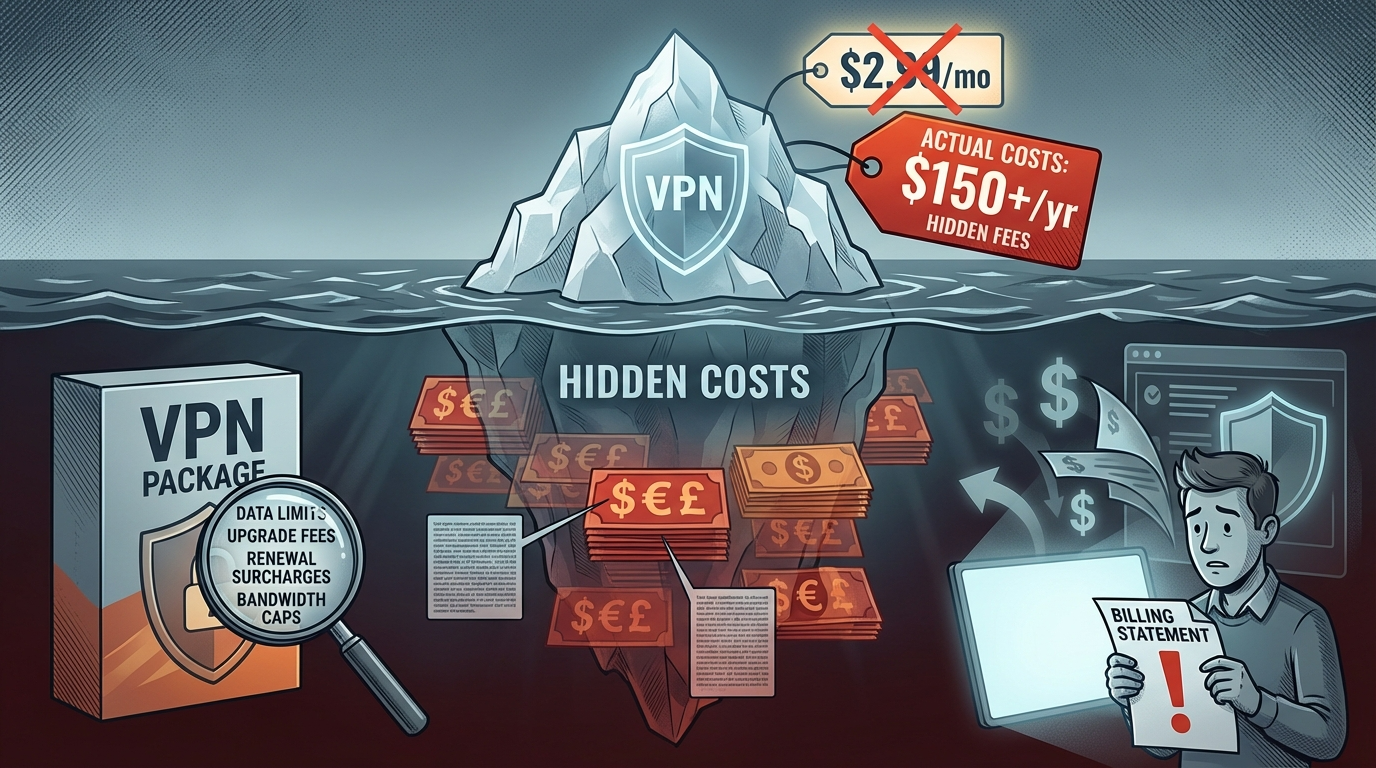
At first glance, VPN apps look affordable. You see a bold headline: “Only $2.99 per month.” It feels like a bargain for online privacy. However, that number rarely tells the full story.
Hidden VPN costs can quietly increase your expenses. Sometimes they appear in renewal pricing. Other times they show up in add-ons, limitations, or feature upgrades. If you don’t read the fine print, your “cheap” VPN may cost more than expected.
So what exactly should you watch for? Let’s unpack the details and uncover the real price behind many VPN subscriptions.
Introductory Pricing and Hidden VPN Costs at Renewal
One of the most common hidden VPN costs appears after your first billing cycle.
Many VPN providers advertise heavily discounted introductory rates. For example, you may pay $2.99 per month for a two-year plan. That sounds appealing. However, once that period ends, the renewal price often jumps dramatically.
Instead of $2.99, you might suddenly pay $9.99 or more per month. That increase can feel shocking if you were not prepared.
Although the pricing terms are usually disclosed, they are often buried in small text. Therefore, before subscribing, check:
- Renewal rate
- Billing frequency
- Auto-renewal settings
- Cancellation deadlines
Understanding long-term pricing protects you from surprise charges.
Auto-Renewal Traps and Subscription Rollovers
Auto-renewal is convenient. However, it can also contribute to hidden VPN costs.
Most providers enable automatic billing by default. When your subscription ends, payment is processed without notice. If you forgot about renewal, you may only discover the charge later.
Additionally, cancellation windows may be strict. Some services require cancellation several days before renewal. Missing that deadline could trigger another full billing cycle.
Therefore, set reminders in advance. Review your subscription settings immediately after signing up. Transparency reduces financial surprises.
Add-Ons That Increase Hidden VPN Costs
Base subscriptions often cover standard features. However, premium tools may require additional fees.
For instance, some VPN providers charge extra for:
- Dedicated IP addresses
- Antivirus integration
- Cloud storage
- Password managers
- Advanced threat protection
At first, these extras seem optional. Yet marketing language may imply they are essential for full protection.
Before adding features, ask yourself whether you truly need them. Sometimes standalone tools offer better value at lower prices.
Moreover, bundling services can create confusion. You may end up paying for features you never use.
Device Limits and Upgrade Fees
Another area where hidden VPN costs appear involves device connections.
Some plans limit you to five or six simultaneous connections. If your household exceeds that number, you may be encouraged to upgrade.
Unlimited plans are often marketed separately at higher prices. Although the difference may seem small, it adds up over time.
Before subscribing, count your devices carefully. Consider laptops, phones, tablets, smart TVs, and gaming consoles. Choosing the right plan upfront prevents upgrade pressure later.
Bandwidth and Speed Limitations
Not all VPN subscriptions provide unlimited data. In some cases, bandwidth caps are quietly included.
For example, certain lower-tier plans restrict monthly usage. If you stream heavily, you may hit the limit quickly. Upgrading becomes necessary.
Similarly, speed throttling can indirectly increase costs. If your VPN slows your connection significantly, you might switch to a higher-priced tier promising better performance.
Therefore, review plan details carefully. Unlimited data and full-speed access should be confirmed before committing.
Refund Policies and Processing Fees
Money-back guarantees sound reassuring. However, hidden VPN costs can appear even in refund processes.
Some providers deduct processing fees from refunded amounts. Others limit refunds to specific payment methods.
Additionally, refund requests may require multiple steps. If deadlines are missed, eligibility disappears.
Before purchasing, read refund terms thoroughly. Understanding the process protects your wallet.
Currency Conversion and International Charges
If you subscribe while traveling, additional fees may apply. Currency conversion charges can inflate the total cost.
Certain banks apply foreign transaction fees automatically. Therefore, even if the VPN price appears fixed, your final statement may differ.
To minimize hidden VPN costs, check whether the provider charges in your local currency. If not, confirm potential conversion fees with your bank.
Free Trials That Aren’t Really Free
Free trials can also lead to unexpected expenses.
Some VPN apps require credit card details upfront. If you forget to cancel before the trial ends, automatic billing begins immediately.
Additionally, trial versions may restrict features. To unlock full functionality, an upgrade is required.
Therefore, treat free trials as temporary tests. Set cancellation reminders and monitor your account closely.
Privacy Trade-Offs as Indirect Hidden VPN Costs
Not all hidden VPN costs are financial. Some involve privacy trade-offs.
Free VPN apps often monetize through advertising or data collection. Although you pay nothing upfront, your browsing behavior may be tracked.
In this case, the real cost is personal information. Data may be shared with third parties to generate revenue.
Therefore, consider the long-term value of privacy. A small subscription fee often provides stronger protection than a free service.
Customer Support Limitations
Lower-priced VPN plans sometimes limit customer support options.
For example, live chat assistance may be restricted to premium tiers. Basic users may rely on email support only.
If technical issues arise, delayed assistance can become frustrating. Although not a direct financial charge, limited support affects overall value.
Before subscribing, verify available support channels.
Contract Length Commitments
Long-term contracts reduce monthly costs. However, they also lock you in.
If you sign a three-year plan, cancellation flexibility decreases. Should service quality decline, switching providers becomes expensive.
While discounts are appealing, flexibility matters too. Balance savings with freedom.
Hidden Taxes and Regional Fees
In certain regions, VAT or digital service taxes are added during checkout. These charges may not appear in initial pricing displays.
Although legally required, they can increase total costs unexpectedly.
Always review final checkout totals carefully before confirming payment.
Evaluating True Value Over Sticker Price
Price alone does not determine value. Instead, consider what you receive for your investment.
Ask yourself:
- Does the VPN provide audited no-logs policies?
- Are servers reliable and fast?
- Is streaming supported?
- Are updates frequent?
Sometimes paying slightly more avoids hidden VPN costs later. Transparent providers often justify their pricing with clear feature lists.
How to Avoid Hidden VPN Costs
Protecting yourself requires proactive steps.
First, read the full pricing breakdown before purchasing. Do not rely solely on promotional banners.
Second, check renewal rates and billing cycles carefully.
Third, review refund terms and cancellation policies.
Fourth, evaluate feature inclusions. Avoid paying for unnecessary add-ons.
Finally, monitor your subscription dashboard regularly.
These actions reduce financial surprises significantly.
When a Higher Price Saves Money
Ironically, the cheapest VPN is not always the most economical.
If low-cost plans require multiple upgrades, total expenses increase. Meanwhile, a slightly higher-priced subscription may include everything upfront.
Therefore, compare comprehensive packages rather than introductory rates.
Value should be measured holistically, not emotionally.
Conclusion: Know the Real Cost Before You Click
Hidden VPN costs rarely appear boldly. Instead, they hide in renewal pricing, feature upgrades, taxes, and policy fine print.
Before subscribing, slow down. Review details carefully. Consider long-term value rather than short-term savings.
By understanding how pricing structures work, you protect both your privacy and your wallet. In the end, transparency should guide your choice. When you choose wisely, your VPN becomes a tool for security, not a source of unexpected expenses.
FAQs
- Why do VPN prices increase after the first term?
Introductory discounts often apply only to initial billing periods. Renewal rates typically reflect standard pricing. - Are free VPNs truly free?
Free services often monetize through ads or data collection, which can compromise privacy. - Can I avoid auto-renewal charges?
Yes, disable auto-renewal in your account settings and set reminders before billing dates. - Do VPN add-ons cost extra?
Many providers charge additional fees for features like dedicated IP addresses or antivirus tools. - How can I spot hidden VPN costs early?
Read full pricing terms, review renewal rates, and check refund policies before subscribing.