
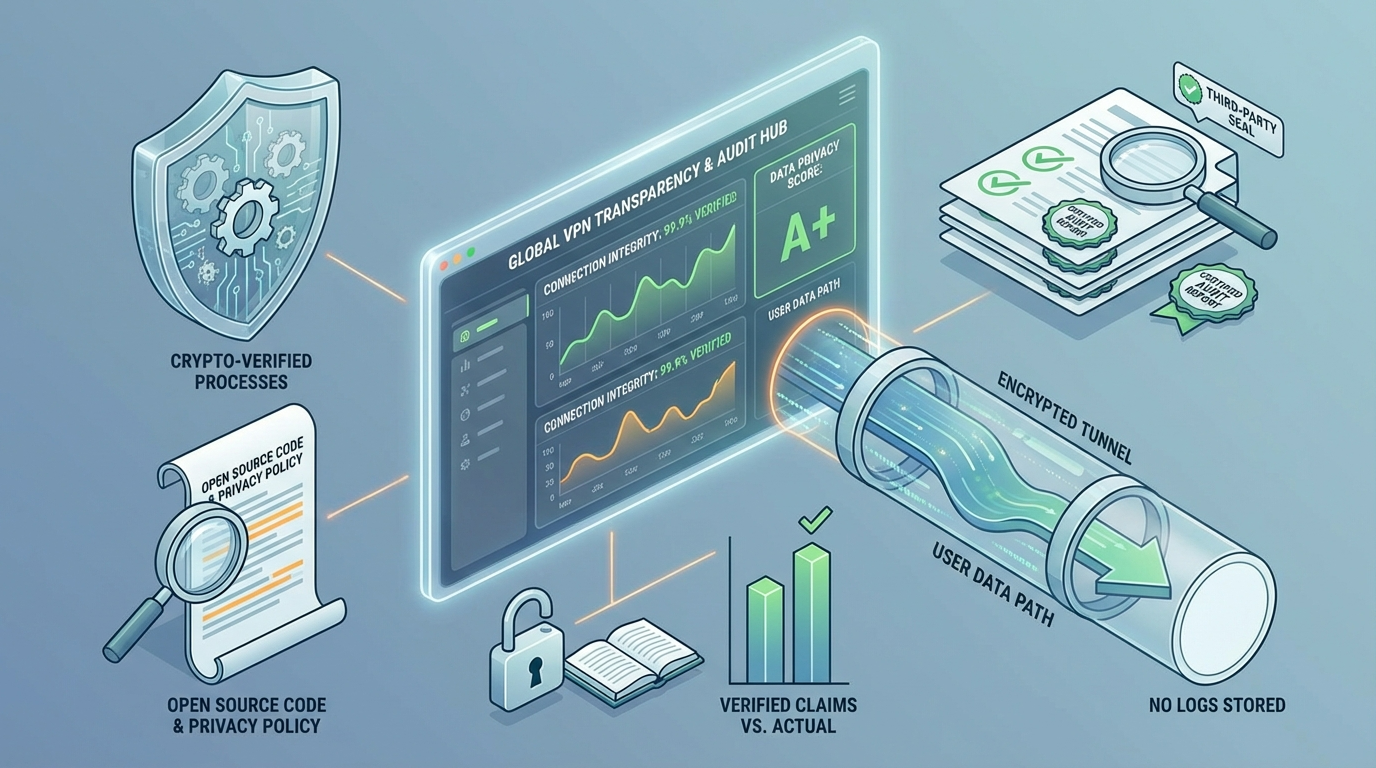
A VPN promises privacy. It claims to hide your IP address, encrypt your traffic, and keep your activity off the record. However, how do you know those promises are real?
Marketing pages look impressive. Privacy policies sound reassuring. Yet words alone do not guarantee protection. That’s where VPN transparency tools become essential.
If you want real privacy, you must test and verify. Fortunately, several tools can help you examine whether your VPN is truly transparent. Instead of guessing, you can rely on evidence.
Let’s explore how to check your provider properly and why verification matters more than slogans.
Why VPN Transparency Tools Matter
Trust is powerful. However, blind trust online can be risky.
A VPN sits between you and the internet. All your data flows through its servers. If that provider logs activity or mismanages data, your privacy could be compromised.
Therefore, VPN transparency tools help you move from assumption to proof. They allow you to test leaks, verify encryption, and examine logging behavior.
Moreover, transparency builds confidence. When a provider welcomes independent testing, it signals accountability.
Without verification, you rely solely on marketing language. With the right tools, you rely on facts.
DNS Leak Tests as Essential VPN Transparency Tools
One of the first checks you should perform is a DNS leak test.
When you browse online, your device sends DNS requests to translate website names into IP addresses. If those requests bypass your VPN, your browsing history could be exposed.
DNS leak test tools are simple to use. Connect to your VPN, then visit a trusted DNS testing website. If your ISP’s DNS servers appear instead of your VPN’s, a leak exists.
This is a critical transparency checkpoint. A provider claiming strong encryption should prevent DNS leaks automatically.
Therefore, regular DNS testing ensures your VPN functions as promised.
IP Address and WebRTC Leak Checkers
Another essential category of VPN transparency tools includes IP leak checkers.
When your VPN is active, your public IP should match the selected server location. If your real IP appears, your privacy is at risk.
Additionally, WebRTC can reveal IP information through browsers. WebRTC leak testers help identify whether your browser exposes your local or public IP.
Although these leaks are not always obvious, they can undermine your anonymity quietly. Testing takes only minutes, yet it reveals significant information.
If leaks are detected, configuration adjustments or browser settings may need updating.
Encryption Verification Tools
Encryption sounds technical. However, verifying it is easier than you might think.
Packet inspection tools can confirm that traffic is encrypted when passing through your VPN tunnel. While advanced software may require technical knowledge, simpler browser-based tests exist as well.
Furthermore, you can examine connection details within your VPN app. Confirm that strong protocols such as WireGuard or OpenVPN are active.
Although encryption cannot always be viewed directly, indirect testing confirms that data is protected.
VPN transparency tools in this category help validate security claims effectively.
Independent Audit Reports
Not all transparency tools are technical. Some involve research.
Reputable VPN providers often commission independent audits. These third-party reviews examine server infrastructure, logging policies, and security measures.
Search for published audit reports. Confirm whether the findings are recent and detailed.
If a provider advertises a no-logs policy, it should be supported by documented audits. Otherwise, the claim remains unverified.
Additionally, transparency reports outlining government data requests add credibility.
Research becomes a powerful transparency tool when used carefully.
Server Location Verification Tools
Many VPN providers advertise hundreds of server locations. However, some servers may be virtual rather than physical.
Server verification tools allow you to check whether the IP address corresponds to the claimed country.
While virtual servers are not inherently unsafe, transparency matters. If a server is marketed as local but routes traffic elsewhere, expectations shift.
Therefore, verifying server geography enhances confidence.
Use IP lookup tools to confirm physical routing locations.
Speed and Performance Testing Tools
Although speed is not directly about privacy, it relates to transparency.
If a VPN advertises ultra-fast performance yet consistently delivers slow speeds, expectations are misaligned.
Speed testing platforms allow you to measure download, upload, and latency metrics with and without the VPN enabled.
Consistent performance supports transparency claims. Significant discrepancies may raise concerns.
Additionally, compare speeds across different server locations.
Testing ensures the service aligns with marketing promises.
Open-Source Code as a Transparency Signal
Some VPN providers release parts of their software as open-source code. This allows independent experts to review and verify security practices.
Although most users will not examine source code personally, the availability of open-source software signals accountability.
When developers welcome scrutiny, trust increases.
Therefore, open-source publication acts as a form of transparency validation.
Privacy Policy Analysis Tools
Privacy policies can be long and complex. However, tools exist to simplify analysis.
Online text analyzers highlight vague language or unclear terms. Phrases like “may collect limited information” deserve closer inspection.
Furthermore, review whether the policy specifies what is not collected. Clear boundaries matter.
If logging practices are described ambiguously, transparency weakens.
Careful reading, supported by digital tools, strengthens understanding.
Checking Ownership and Corporate Structure
Transparency extends beyond technical performance.
Investigate the company behind the VPN. Who owns it? Where is it headquartered? Has it changed ownership recently?
Corporate research tools and business registries provide insight.
If ownership is hidden or unclear, caution may be warranted.
Transparent providers typically share leadership information openly.
Monitoring App Permissions
Another practical category of VPN transparency tools involves app permission monitoring.
On mobile devices, review which permissions the VPN app requests. Excessive access to contacts, cameras, or storage may be unnecessary.
Although some permissions support functionality, unnecessary requests raise questions.
Therefore, evaluate whether permissions align with stated features.
User Reviews and Independent Testing Labs
Community feedback can also serve as a transparency indicator.
Look for reviews from independent cybersecurity labs. These organizations conduct objective testing.
Additionally, examine user experiences on trusted platforms.
While individual complaints may vary, consistent patterns reveal reliability.
Transparency grows when independent voices confirm claims.
How Often Should You Use VPN Transparency Tools?
Verification should not be a one-time activity.
Software updates occur regularly. Server infrastructure changes. Ownership structures evolve.
Therefore, periodic testing ensures ongoing reliability.
For example, perform DNS and IP leak tests monthly. Review audit updates annually.
Routine checks maintain confidence over time.
Balancing Trust and Verification
Using VPN transparency tools does not mean distrusting every provider. Instead, it reflects responsible digital behavior.
Think of it like checking your bank statements. You trust your bank, yet you still review transactions.
Similarly, transparency tools allow you to verify without suspicion.
Healthy verification builds stronger trust.
When Transparency Is Missing
If testing reveals leaks or inconsistencies, take action.
Contact customer support. Ask for clarification. Review settings carefully.
If concerns persist, consider switching providers.
Your privacy should never depend solely on promises.
Conclusion: Make Transparency a Habit
VPN transparency tools empower you to protect your privacy proactively. Instead of relying on marketing language, you rely on measurable evidence.
Test for leaks. Review audit reports. Analyze policies. Monitor permissions. Research ownership. Repeat periodically.
True privacy is built on verification, not assumption. When you adopt transparency as a habit, your VPN becomes more than an app. It becomes a trusted guardian, supported by evidence and accountability.
FAQs
- What are VPN transparency tools?
They are tools and research methods used to verify a VPN’s security, logging, and privacy claims. - How do I check for DNS leaks?
Connect to your VPN and use a trusted DNS leak testing website to verify server routing. - Are independent audits important?
Yes, audits confirm that logging policies and infrastructure align with stated privacy promises. - Can I verify server locations?
Yes, IP lookup tools help confirm whether a server’s physical location matches its advertised region. - How often should I test my VPN?
Regular monthly checks for leaks and annual policy reviews help maintain consistent transparency.